
See the situation another way.
Problem
One reading can become the only reading.
A stakeholder pushes back, a meeting goes badly, a colleague's behaviour puzzles you. You settle on an explanation, and soon everything you see seems to confirm it.
When only one interpretation feels possible, your options narrow with it.
Acknowledgement
Having a view isn't the problem.
You need a working explanation to act at all, and yours may well be right. The difficulty is that a settled view rarely tests itself.
Understanding
Why it's hard to see past your own view
A perspective is built from real observations plus interpretation of motive, cause or scope. The interpretation is the part that feels most certain and gets checked least.
An alternative only helps if it fits the same facts. Contradiction for its own sake doesn't.
What Pygar looks at
- Your perspective, restated faithfully
- What genuinely supports it
- Where interpretation is doing the work
- One alternative that fits the same facts
- What would help tell the two apart

Solution
One credible alternative, not a debate.
Say how you currently see the situation. Pygar doesn't assume you're wrong. It shows one other reading the facts allow, and how to find out which fits.
- 1
Say how you see it
Describe your current view in your own words.
- 2
See it tested
What supports your view and where interpretation is carrying it.
- 3
Meet one alternative
A single credible reading of the same facts, labelled as a hypothesis.
- 4
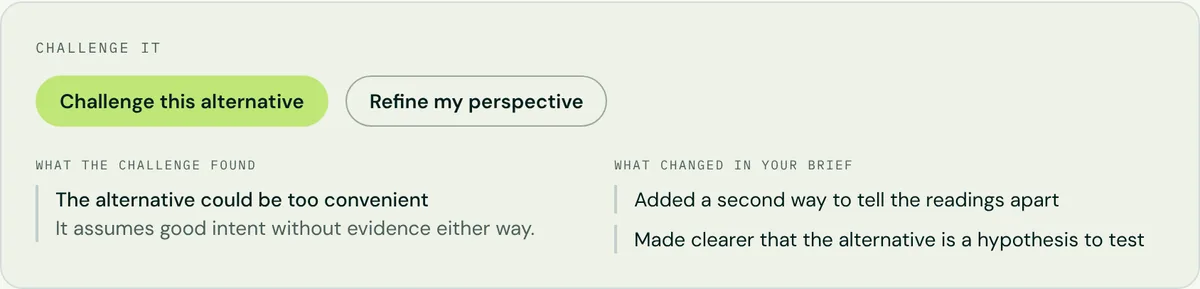
Challenge or refine
Test the alternative, or update your view with what you know.
- 5
Save it
Keep both readings with the situation and decide the next step.
What's in your brief
- Your current perspective
- A faithful, concise restatement.
- What supports it
- What in your account makes it credible.
- Where the perspective is doing interpretive work
- Only the inference that matters.
- A credible alternative perspective
- One alternative, labelled as a hypothesis.
- What the alternative explains
- Why it also fits what you know.
- What changes if you hold both possibilities
- The effect on your questions, tone and preparation.
- What would help distinguish them
- Concrete evidence, questions or observations.
A real-world situation
What this looks like in practice
A stakeholder who keeps challenging your plan
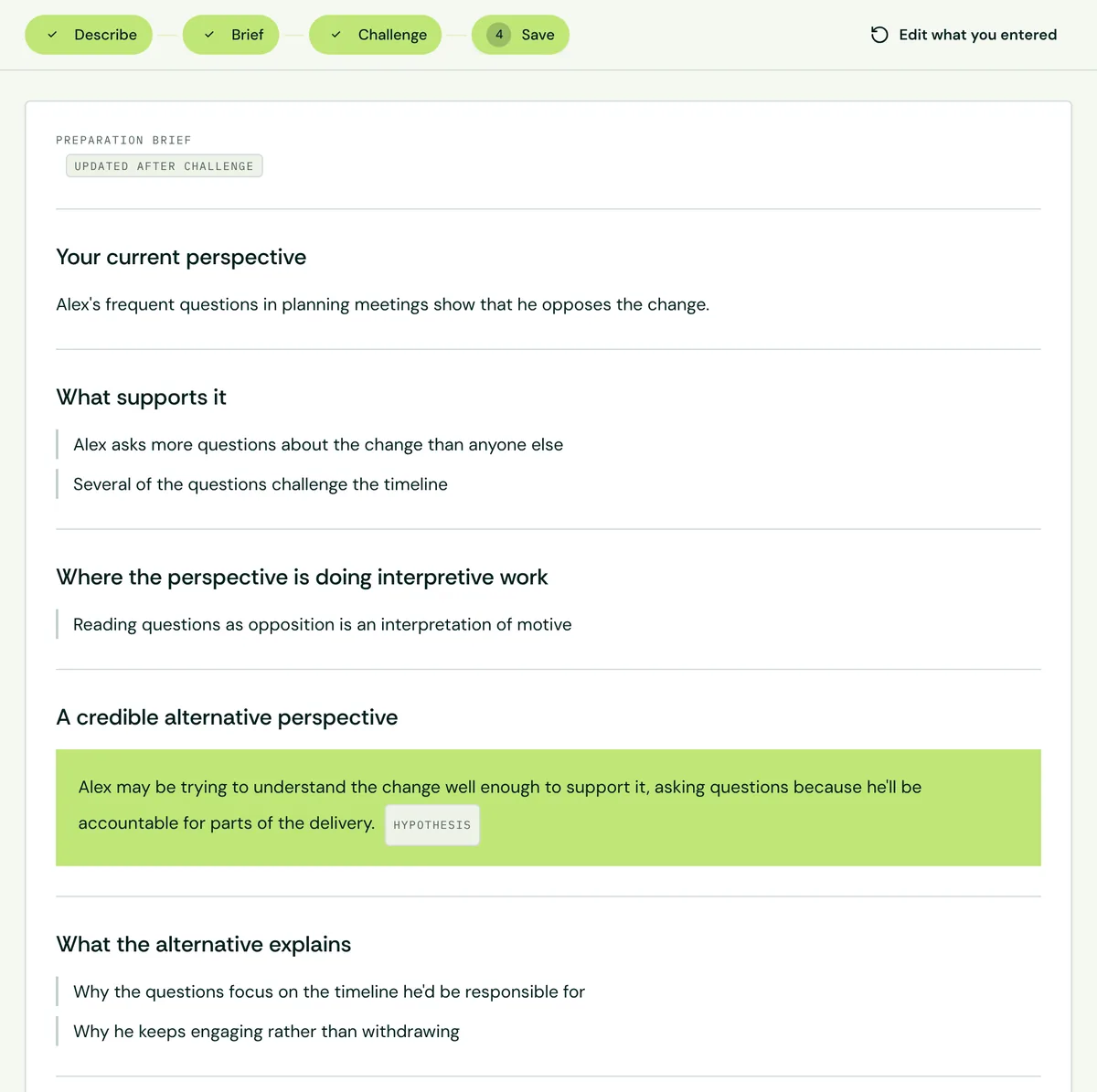
The situation. You believe a stakeholder is resisting your proposal because they dislike change.
How Pygar helps. Examine what supports that interpretation and consider a credible alternative, such as legitimate unanswered concerns about delivery or risk. Identify what would help you test the two readings.
The human side. Approach the next conversation with curiosity and open questions rather than a fixed judgement about motive.
Illustrative example, not an account of a real customer or a promised outcome.
When to use it
- Interpreting stakeholder resistance
- Making sense of someone's behaviour
- A meeting that seemed to go badly
- Feeling there's only one option
- A conflict you see only one way
- Before a discussion where interpretation matters
What you get
A wider view
See a credible reading you may be missing.
Your view respected
Restated faithfully, not argued against.
Practical next steps
See what changes if both readings are possible.
Ways to find out
Questions and evidence that would tell them apart.
What it won't do
- Pygar doesn't assume your view is wrong.
- It never contradicts observable facts just to be different.
- The alternative is a hypothesis, never a verdict.
- It won't claim to know anyone's motives.
Works well with
Every product works on the same situation, so you can take what you've prepared into the next one without starting again.