
Check your reasoning before you make the call.
Problem
Judgements about people carry weight.
Changing someone's responsibilities, deciding how seriously to take a repeated problem or escalating a concern can shape a person's working life.
Yet these judgements are often formed quickly, from a mix of evidence, impressions and things other people have said.
Acknowledgement
Checking first is the fair thing to do.
Wanting to test your thinking before you act shows you take the decision seriously. It's also hard to do alone, because reasoning that feels sound from the inside is the hardest to see from the outside.
Understanding
Where reasoning goes wrong
Broad labels such as “unreliable” are interpretations unless specific evidence supports them. Direct evidence and hearsay end up weighed the same.
A standard applied to one person may not be applied to another. And the real issue may turn out to be expectations, clarity, resources or communication.
What Pygar looks at
- Your evidence, and how direct it is
- Evidence that's missing or weak
- Assumptions shaping the judgement
- Whether one standard is applied to all
- Credible alternative explanations

Solution
A second look at your reasoning, never a verdict.
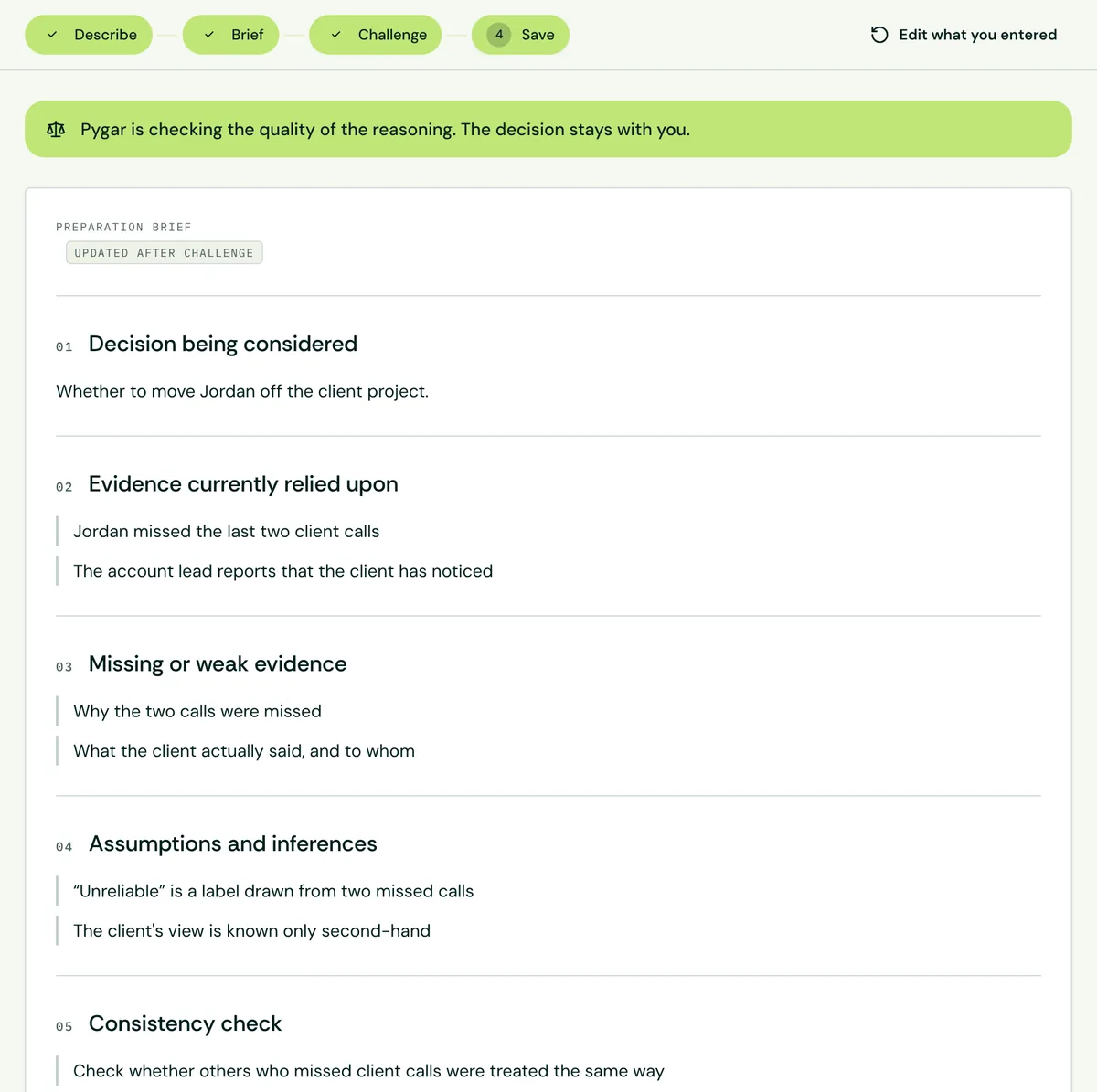
Describe the decision you're considering in your own words. Pygar extracts the standard you appear to be applying and checks the reasoning around it.
- 1
Describe the decision
Say what you're considering and why, in your own words.
- 2
Get your check
Evidence, gaps, assumptions, consistency, alternatives, open questions and possible consequences.
- 3
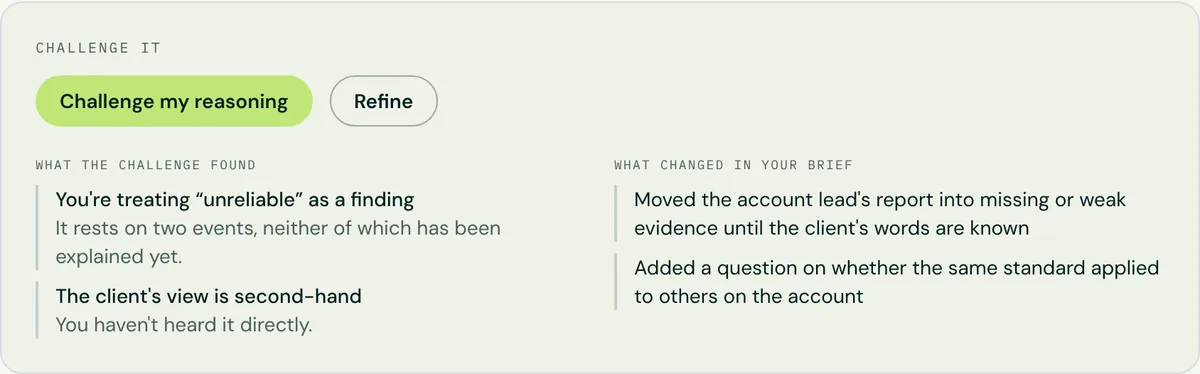
Challenge my reasoning
Pygar asks what would change your view and whether you'd apply the same standard to someone else.
- 4
Prepare the conversation
If the next step is a discussion, see what needs talking about, without deciding the outcome.
- 5
Save it
Keep the check with the situation and note what happened.
What's in your brief
- Decision being considered
- A neutral restatement.
- Evidence currently relied upon
- What you've actually supplied.
- Missing or weak evidence
- What isn't adequately established.
- Assumptions and inferences
- What may be shaping the judgement.
- Consistency check
- Whether the standard appears consistently applied.
- Alternative explanations
- Credible explanations you may not be considering.
- Questions still needing answers
- What to establish before you decide.
- Potential unintended consequences
- What could follow from acting on an incomplete view.
- Communication preparation
- What to discuss if the next step is a conversation.
A real-world situation
What this looks like in practice
A consequential decision about a colleague
The situation. You are considering changing someone’s responsibilities after repeated problems with delivery.
How Pygar helps. Check whether your evidence is complete, your standards are consistent and alternative explanations have been considered. The decision and accountability remain with you.
The human side. Prepare the questions you may need to discuss. Communication colours and other preferences must never be used as evidence for or against a person.
Illustrative example, not an account of a real customer or a promised outcome.
When to use it
- Interpreting a repeated problem
- Changing someone's responsibilities
- Checking a performance concern is evidenced
- Applying a standard consistently
- A recommendation involving a person
- Preparing for a formal or informal discussion
- Before escalating a concern
What you get
Evidence you can stand behind
Know what's established and what isn't.
One standard for everyone
Check you'd apply the same test to anyone.
Alternatives considered
See explanations you may have missed.
Consequences thought through
See what could follow from acting too soon.
What it won't do
- Pygar never makes or recommends the decision.
- It won't rank people, score suitability or recommend hiring, promotion, pay, discipline, dismissal or redundancy.
- Notes on how someone communicates are never treated as evidence.
- Asked to decide, it explains what it can help with instead.
Works well with
Every product works on the same situation, so you can take what you've prepared into the next one without starting again.