
Hear the hard questions before the room asks them.
Problem
Good cases get lost in the room.
You've worked on the proposal. Then someone asks a question you hadn't considered, or for evidence you don't have to hand, and the discussion moves away from what you came to ask for.
From the inside, it's hard to see which of your claims are stronger than the evidence behind them.
Acknowledgement
Being challenged is part of the job.
Challenge is how a room tests whether a case is ready. Feeling exposed by it usually means the hardest questions arrived before you'd had the chance to answer them yourself.
Understanding
Why predictable objections still catch people out
When you're close to a case, its assumptions start to feel like facts.
Each person in the room looks at it through their own concerns. Finance asks about the numbers. Operations asks whether it can be delivered. Many of those questions can be answered in your first two minutes, if you know they're coming.
What Pygar looks at
- The actual ask and the core argument
- Your strongest evidence and weakest point
- Claims stronger than the evidence allows
- What the room is likely to ask for
- What you can cover in your opening

Solution
Test the case, then let the meeting test you.
Describe what you're presenting and to whom. Add the proposal itself if you like. Pygar prepares a brief built around what you should cover upfront.
- 1
Describe the case
Say what you're presenting, who will be there and what you need from them.
- 2
Get your brief
Your argument, evidence, weak points, likely questions, objections and what to cover first.
- 3
Challenge the case
Pygar looks for overstated claims, missing evidence and exposed assumptions, then updates the brief.
- 4
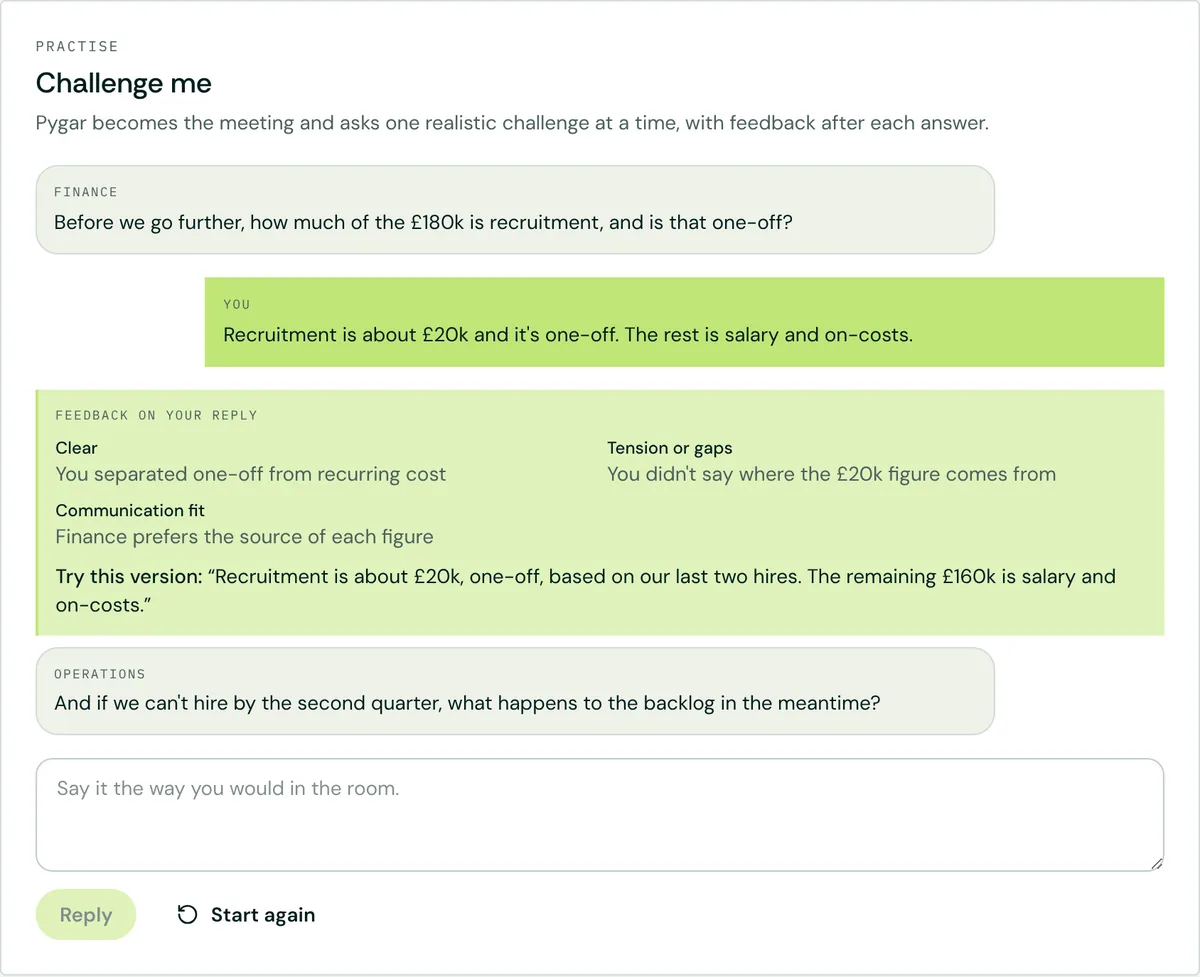
Challenge me
Pygar becomes the meeting and asks one realistic challenge at a time, with feedback on each answer.
- 5
Save it
Keep your improved opening and return to the situation after the meeting.
What's in your brief
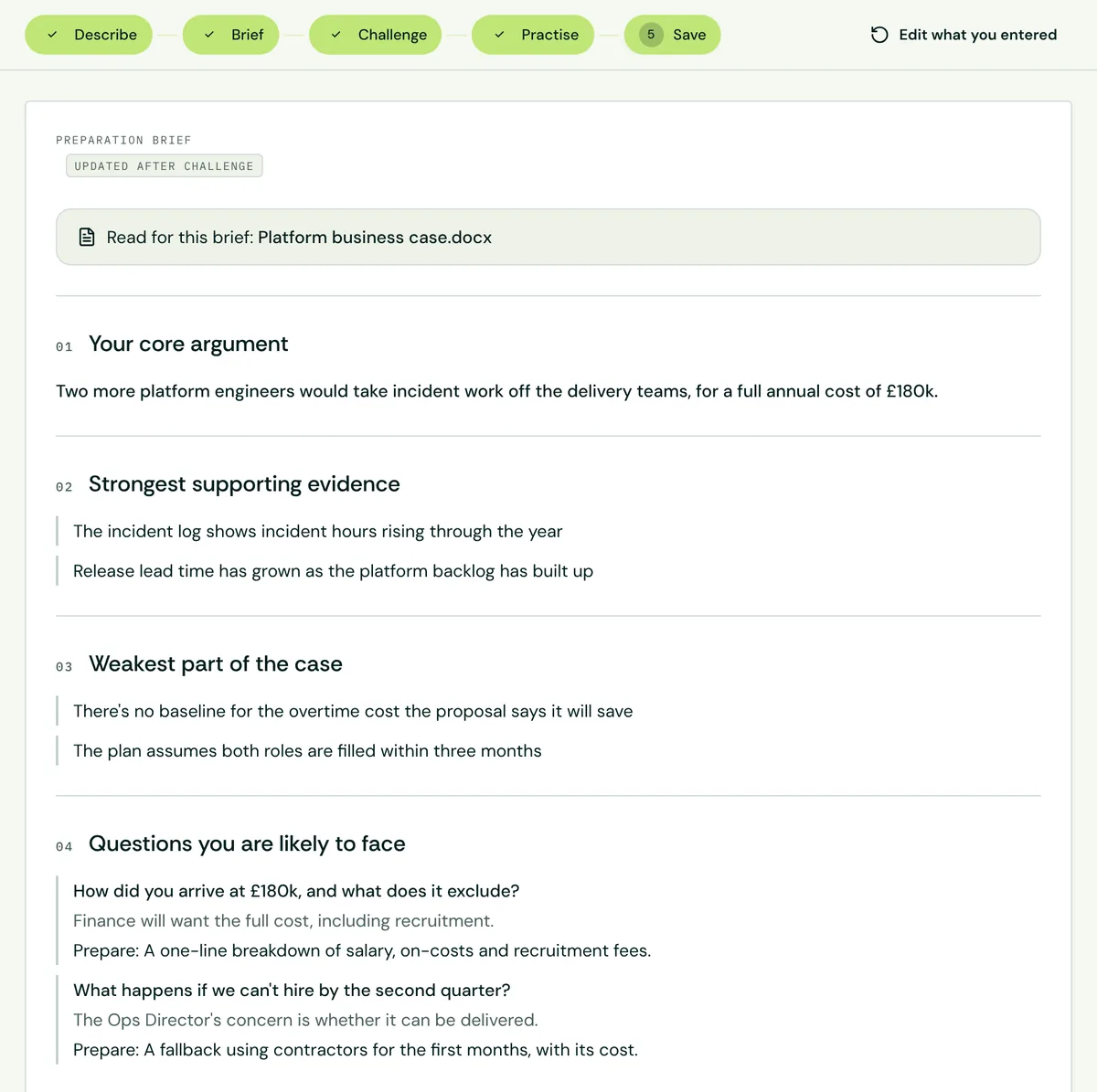
- Your core argument
- One concise statement of the case.
- Strongest supporting evidence
- What genuinely supports it.
- Weakest part of the case
- Where you're exposed.
- Questions you are likely to face
- Each with why it's likely and how to prepare.
- Evidence likely to be requested
- What the room may ask to see.
- Stakeholder objections
- Plausible challenges by role, never invented motives.
- Missing evidence and exposed assumptions
- What to obtain, acknowledge or rely on.
- Claims to soften or strengthen
- Which claims need qualifying or backing.
- Cover upfront
- Predictable challenges to deal with before they're raised.
- Build into your opening
- An improved first two minutes.
Your documents, with your consent
Add up to three documents, such as a proposal, deck or business case. They're read on your device, you see what Pygar will read, and they're used for that Meeting Challenge only.
Prepare the Room
If you keep notes on how attendees communicate, or colleagues share their Card with you, the brief suggests how to present to each of them. It never predicts whether anyone will agree.
A real-world situation
What this looks like in practice
A proposal heading into a difficult meeting
The situation. You need approval for extra resource. You believe the business case is strong, but the finance and operations teams may challenge different parts of it.
How Pygar helps. Examine the strongest evidence, highlight unsupported claims, anticipate plausible stakeholder objections and practise responding one question at a time.
The human side. When attendees’ preferences are known, Prepare the Room can help you plan a presentation that balances the headline, supporting detail and discussion.
Illustrative example, not an account of a real customer or a promised outcome.
When to use it
- Getting a proposal approved
- Asking for budget or resource
- Resetting a project
- Changing an operating model
- Presenting a transformation
- A client review
- A governance or steering group
- A board or leadership presentation
- Recommending a decision
- Defending delivery assumptions
What you get
Objections answered early
Cover predictable challenges in your first two minutes.
Know where you're exposed
See your weakest points and missing evidence first.
Claims you can stand behind
Know which claims to soften and which to strengthen.
Answers you've rehearsed
Practise responding to the room, one question at a time.
What it won't do
- Pygar won't invent stakeholder motives.
- It never predicts whether anyone will agree or oppose.
- Documents are read only for the session you add them to.
- It never reads your files, inbox or chats on its own.
Works well with
Every product works on the same situation, so you can take what you've prepared into the next one without starting again.