
Separate what you know from what you're assuming.
Problem
Conclusions arrive before the evidence does.
A project is slipping and you think you know why. A colleague seems resistant and you think you know what's behind it. The explanation feels obvious, so it rarely gets checked.
Acting on it means building on something that may not be established.
Acknowledgement
Filling the gaps is what minds do.
Making sense of incomplete information is how people cope with busy, uncertain work. The risk isn't having assumptions. It's not knowing which ones you're relying on.
Understanding
Why assumptions are hard to see
An inference starts to feel like knowledge once you've said it a few times. A reading of someone's motive sounds like an observation.
And what you don't know is, by its nature, easy to overlook.
What Pygar looks at
- What your evidence actually supports
- What follows, but isn't established
- What you're treating as true without proof
- What material information is missing
- What must hold, and what would disprove it

Solution
Four categories, then a test.
Write down what you believe is going on. Assumption Check is deliberately short, so it clarifies your thinking rather than burying it in a report.
- 1
Say what you believe
Describe what you think is happening, in plain words.
- 2
See it sorted
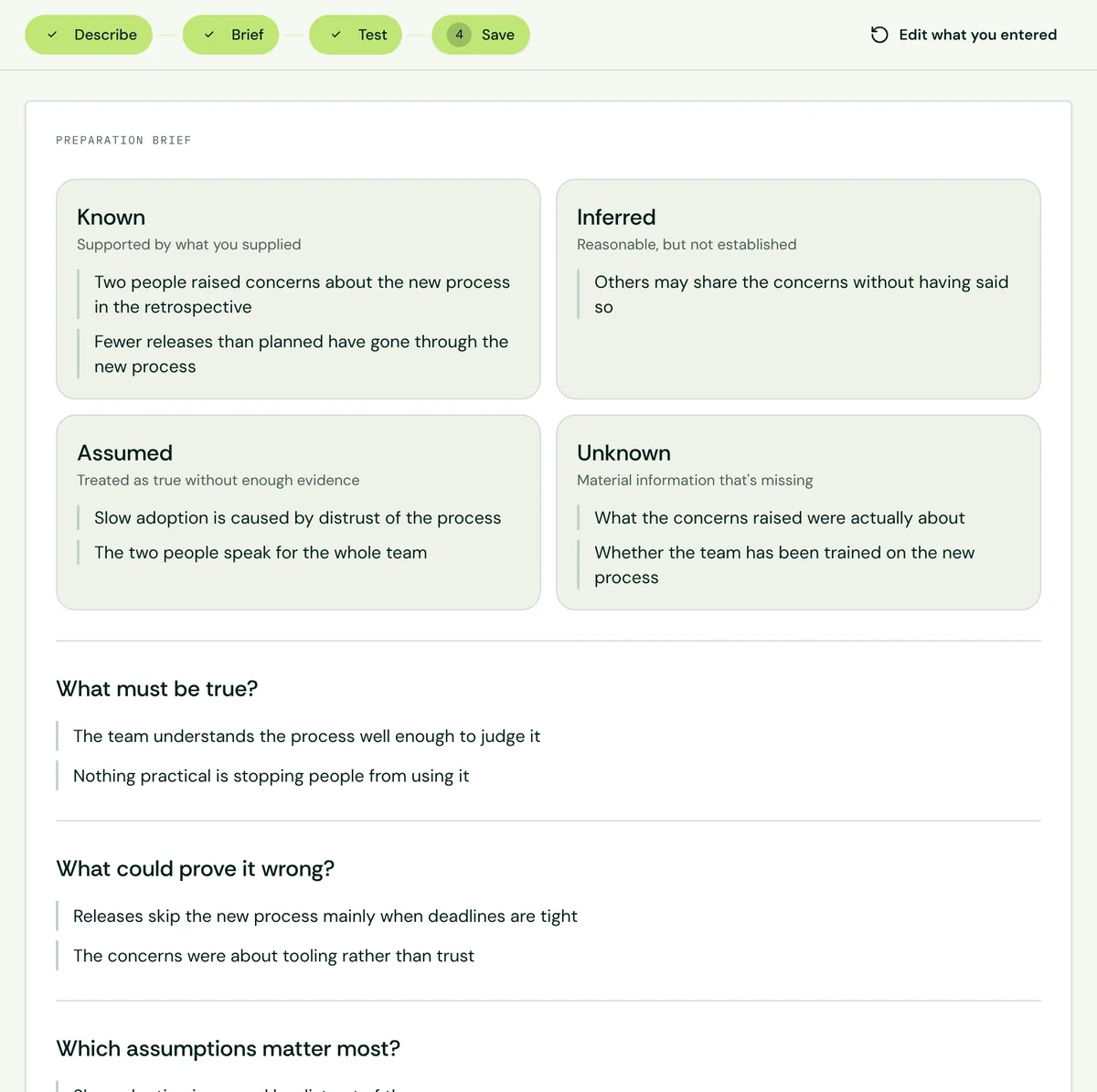
Known, Inferred, Assumed and Unknown, each kept short.
- 3
Find what matters
What must be true, what could prove it wrong and which assumptions matter most.
- 4
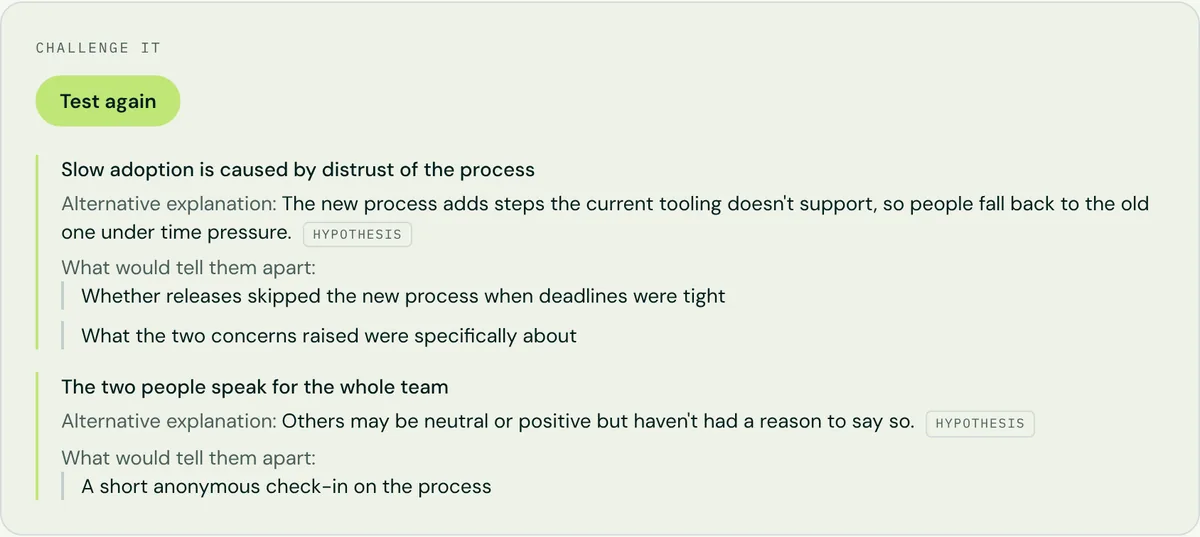
Test the assumptions
For the most consequential, a credible alternative and the evidence that would tell them apart.
- 5
Save it
Keep the check with the situation, and carry what you found into the next product if Pygar suggests one.
What's in your brief
- Known
- What the evidence you supplied supports.
- Inferred
- A reasonable interpretation that isn't established.
- Assumed
- What's treated as true without enough evidence.
- Unknown
- Material information that's missing.
- What must be true?
- What your current interpretation depends on.
- What could prove it wrong?
- Concrete evidence or events that would disconfirm it.
- Which assumptions matter most?
- Only those with real consequences, up to three.
A real-world situation
What this looks like in practice
A delayed project with an uncertain cause
The situation. The project is slipping. You suspect poor ownership, but dependencies and priorities have also changed.
How Pygar helps. Separate observable facts from inferences, assumptions and unknowns. Identify the explanations that matter most and the evidence that could distinguish them.
The human side. Take a better-informed set of questions into the next discussion instead of treating a possible motive as a fact.
Illustrative example, not an account of a real customer or a promised outcome.
When to use it
- Interpreting someone's behaviour
- Explaining why a project is failing
- Expecting stakeholders to resist
- Making sense of poor delivery
- Believing a customer wants something
- Deciding with incomplete evidence
- Before a difficult conversation
What you get
Clarity in minutes
A sharp check, not a long report.
Your weak points, visible
See the assumptions your view depends on.
Ways to find out
Evidence that would confirm or challenge your view.
Questions worth asking
Unknowns become things you can go and establish.
What it won't do
- Pygar won't turn interpretations into facts.
- It won't claim to know anyone's motives.
- Alternative explanations are labelled as hypotheses.
- It won't recommend a consequential decision.
Works well with
Every product works on the same situation, so you can take what you've prepared into the next one without starting again.