
Prepare for the conversation you need to have.
Problem
Some conversations are hard to start.
A deadline has been missed again. Someone's behaviour is affecting the team. An expectation needs resetting. You know the conversation has to happen, and you know it could go badly.
Under pressure, it's easy to walk in with a conclusion instead of evidence, or with words that land harder than you mean them to.
Acknowledgement
Wanting to get it right is a good sign.
Putting a conversation like this off often comes from caring how it lands. The hesitation usually means you don't yet know what to say, what to have ready or how it may be heard.
Understanding
What makes it difficult
In the moment, facts and interpretations blur. “He doesn't care” feels like an observation, but it's a reading of someone's motive.
Vague or collective phrases such as “everyone has noticed” invite defensiveness. And the other person will have questions you haven't prepared for.
What Pygar looks at
- What the conversation is really about
- What's fact and what's interpretation
- What the other person may reasonably ask
- How your wording may be heard
- What a fair, natural opening sounds like

Solution
Prepare it, challenge it, then practise it.
Say who it's with and describe the situation the way you'd say it. Pygar goes straight to a preparation brief.
- 1
Describe it
Say who it's with, their role and how they relate to you, then describe it in your own words.
- 2
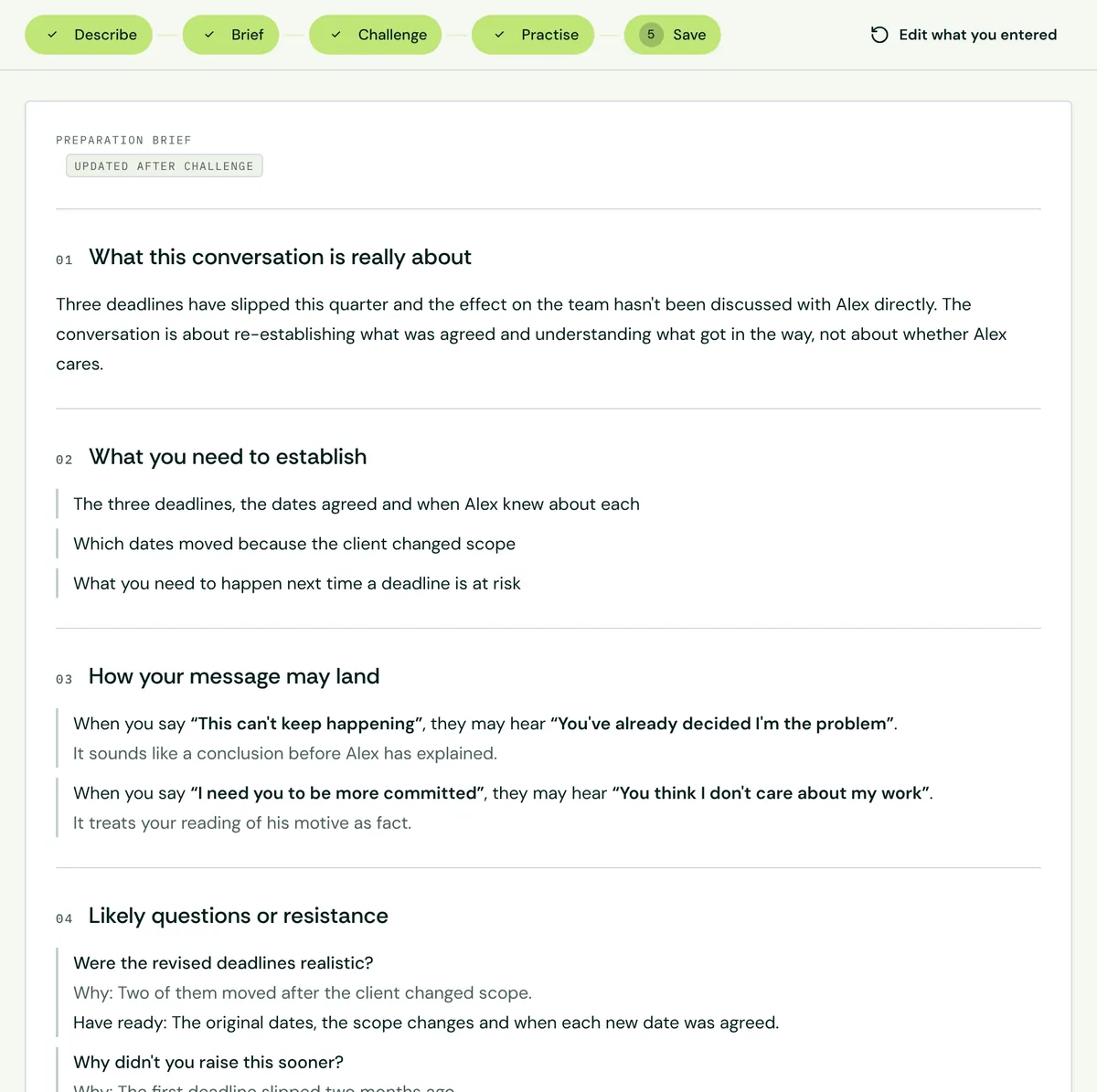
Get your brief
A short brief, not an essay. Each part is something to understand, have ready or say differently.
- 3
Challenge your approach
Pygar tests the brief for vague claims, overstatement, missing evidence and a weak opening, then updates it.
- 4
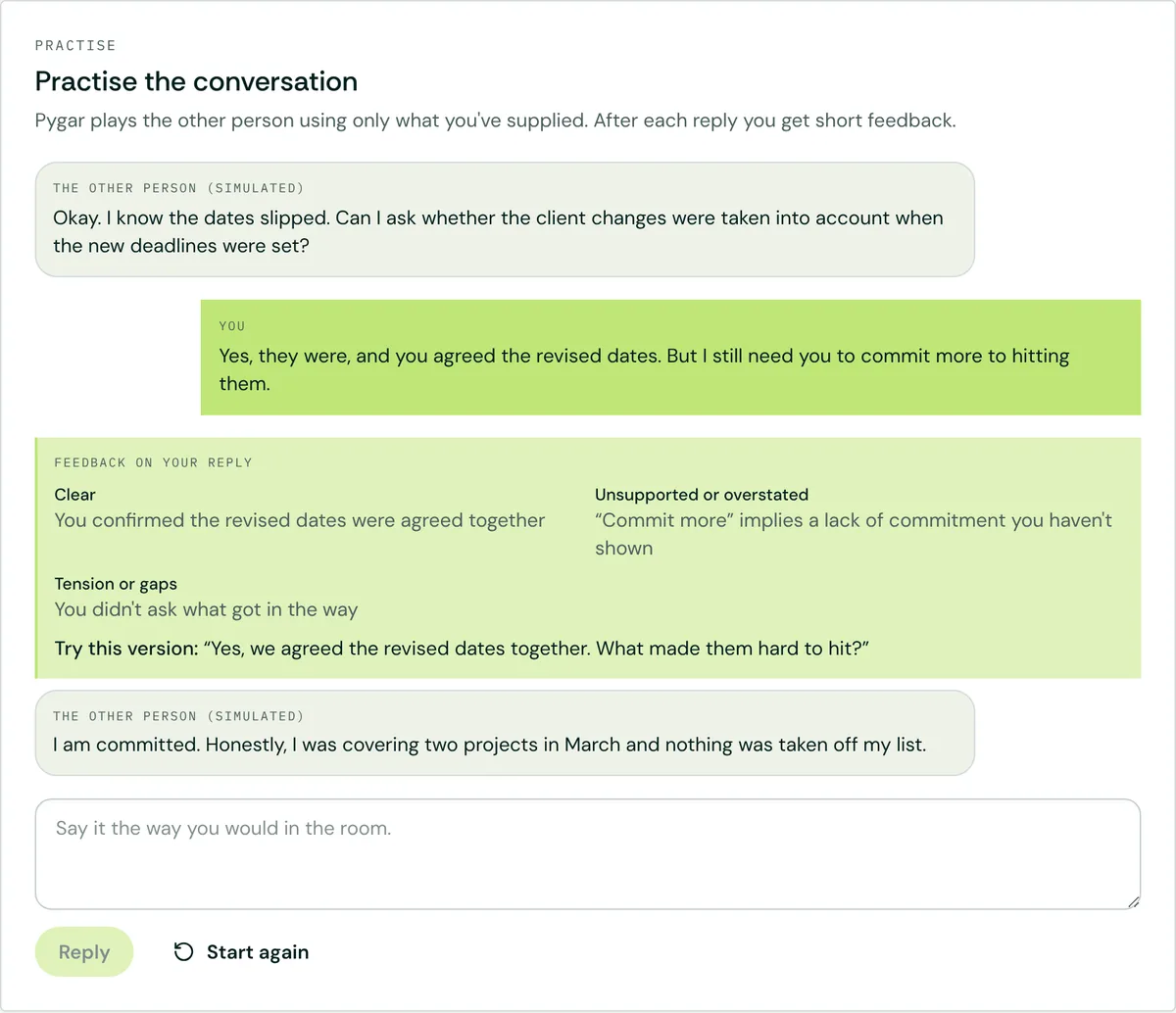
Practise the conversation
Pygar plays the other person, using only what you've supplied, with feedback after each reply.
- 5
Save it
The work stays with the situation, so you can come back to it and note how it went.
What's in your brief
- What this conversation is really about
- The real issue, without diagnosing the person.
- What you need to establish
- Facts, expectations and examples to be clear on first.
- How your message may land
- When you say one thing, what they may hear.
- Likely questions or resistance
- What they may ask, why, and what to have ready.
- Evidence and examples to have ready
- Concrete preparation, such as dates and agreed deadlines.
- Things to avoid
- Wording that sounds prejudged, vague or accusatory.
- Suggested opening
- Short, natural words you could actually say.
- What a useful outcome looks like
- What success means, without deciding consequences.
A real-world situation
What this looks like in practice
A missed deadline without an accusation
The situation. A colleague misses an important deadline for the third time. You are concerned they do not care about the impact on the team.
How Pygar helps. Distinguish missed deadlines, which can be evidenced, from assumptions about intent. Gather examples, prepare a clear opening and practise answering questions without prejudging the explanation.
The human side. Where you know the colleague’s preferences, consider the amount of context, directness and time for reflection that may help the conversation.
Illustrative example, not an account of a real customer or a promised outcome.
When to use it
- Repeated missed deadlines
- A performance or delivery concern
- Behaviour causing friction in the team
- Setting a boundary
- Giving difficult feedback
- Challenging a decision
- Resetting expectations
- Explaining a difficult change
- A working relationship that has broken down
- Raising an issue without escalating it
What you get
Evidence, not assumptions
Go in with specific examples and the facts you need to establish.
Words that land as meant
See how your message may be heard before you say it.
Ready for pushback
Prepare for the questions and resistance that are likely to come.
Practice without pressure
Rehearse until the opening feels like your own words.
What it won't do
- Pygar won't diagnose, label or judge the other person.
- It won't recommend discipline, dismissal or any other employment outcome.
- It never treats a guess about someone's motive as fact.
- The practice uses only what you've told it, never invented history.
Works well with
Every product works on the same situation, so you can take what you've prepared into the next one without starting again.